The Fourth Watch
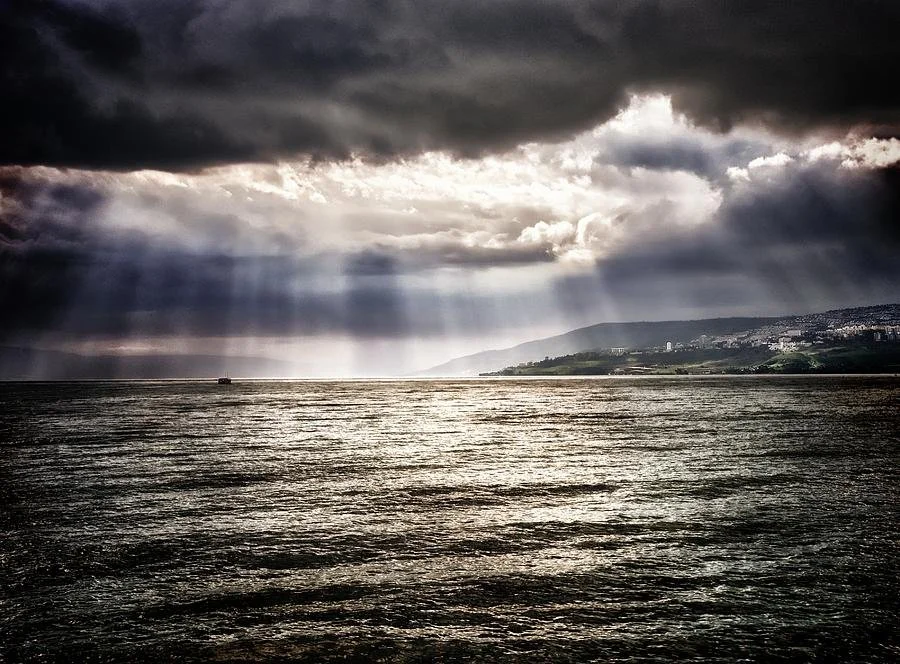
Sea of Galilee— Modern Day (Mark Fuller Photography)
📜 The Word
“And in the fourth watch of the night he came to them, walking on the sea. But when the disciples saw him walking on the sea, they were terrified, and said, “It is a ghost!” and they cried out in fear.”
— Matthew 14:25
🌎 The World Behind the Word
We talked a bit about chapter Matthew chapter 8 a week or so ago. The boat discussed there is probably the same boat talked about in this story. Not long before the walk-on-water scene, Jesus quelled a different storm. The chronological nature of the bible is real, yet we often skip around so it feels like disconnected stories. They aren’t and they show a progression to the reality of the Story of Christ. For reference, here is a contrast of the two events.
The Tale of Two Boats (Matt 8 and Matt 14)
Feature
Jesus's Location
Disciples Question
Their Conclusion
Their Action
1st Storm (Matt 8)
Sleeping in the boat
"What kind of man is this?"
"Even winds/sea obey him"
Amazment and marvel
2nd Storm (Matt 14)
Walks on water
No questions asked
"Truly you are the son of God"
On their knees Worship
I hope it comes out in the email— apologies if it is screwy. Also, the images today are actual modern photographs of the Sea of Galilee. Enjoy the art of Reality!
❓ Did It Really Happen ❓
Picking up where we left off on Friday— sorry for the delay but I had some computer problems and I’m glad I did, it gave me more time to go “deeper”… yet another disaster that led to revelation!
The Fourth Watch:
The specific mention that this happened during the "fourth watch of the night" (between 3:00 AM and 6:00 AM) is a typical eyewitness marker— sometimes even used to this day. It places the event in the most exhausting, disorienting time of day for sailors, adding a layer of psychological realism to their initial fear ("It is a ghost!").
“The Rock”, um, I mean Peter:
This isn't just a story about Jesus being amazing; it’s a story about Peter—the future leader of the church—failing spectacularly. He doubts, he sinks, and he’s critiqued—
“You of little faith, why did you doubt?”. If you think about it, that’s a pretty funny thing to say— a matter of fact, “you could have kept walking on water too if you believed, dummy.”
If the early church was just "inventing" myths to look powerful, they probably wouldn't have portrayed their founding Bishop as a guy who lacked the faith to stay afloat.
In the gospels, notice that upon Jesus proclaiming he is the one who has come, Peter doesn’t just jump out. Instead, he says, “Lord, if it is you, command me to come to you on the water” (Matthew 14:28).
The Logic: Peter recognizes that the "I AM" is the source of the discarding of natural law. He isn't asking for a superpower; he’s asking to participate in Jesus' authority.
The Command: Jesus says one word: Elthe ("Come"). Not, “good luck”, “you’ll sink”…. he says, “COME”.
The Weight: In the Greek, this implies that the "word" of Jesus becomes the literal platform for Peter’s feet. As long as Peter is tethered to that command, the "natural law" of surface tension is overruled by a "higher law."
But wait, Peter was doing pretty good… up until he “saw the wind”.
Who “sees” the wind? He would have seen the effects of the wind. The waves, the sound, the spray of water. The potential for death— FEAR.
My Analysis: This is a psychological thriller for the time. Peter shifted his focus from the Source (Jesus) to the Circumstance (the storm).
The Result: The moment he prioritized the "natural" over the "supernatural," the natural laws (gravity and buoyancy) immediately re-asserted themselves. He didn't just slowly drift; he began to sink.
The Rescue…
“Jesus immediately reached out his hand and caught him”
The Greek is epelabeto (ἐπελάβετο)— it means “to take hold”. It is a verb which has a different flavor than the translation “reached out his hand and caught him” we are used to. To take hold means that Jesus was close enough to grab Peter— thus, Peter was with the “I AM” but lost his faith for a moment.
The skeptics wills point to their natural law and say, “see, human’s can’t walk on water”.
They are right and the story agrees with them and makes my belief have greater power…
It shows as soon as Peter acted like a normal human he sank like one.
The miracle points to something entirely dependent on a relationship with Jesus, at that moment, not just the Son of God, but the Son in the Trinity turned into the complete I AM. For that moment, at least, God himself!
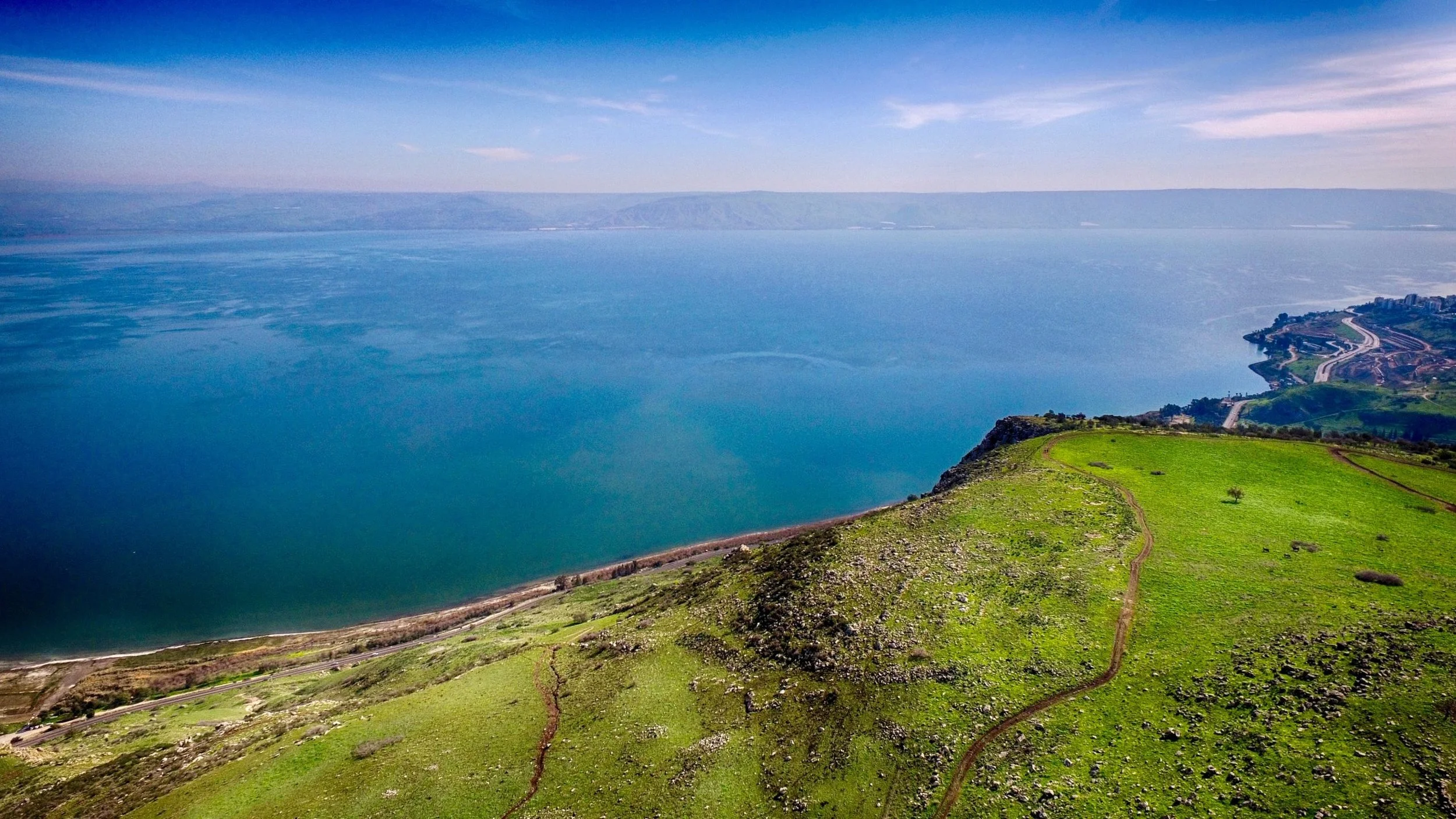
Real photo from the eastern shore of the Sea of Galilee, I believe at the Mount of the Beatitudes
To give this story its final layer of "weight," we have to look at the Sea of Galilee not as a peaceful Sunday school backdrop, but as a topographical "wind tunnel." The geography explains why these seasoned fishermen—men who made their living on this water—were genuinely terrified for their lives. I had no idea what I was in for when I took a look at this—…
1. Something they call the "Basin" Effect
The Sea of Galilee is the lowest freshwater lake on Earth, sitting at about 210 meters (690 feet) below sea level (Death Valley is 210 feet below sea level). It is surrounded by steep hills and mountains, particularly the Golan Heights to the east.
The Physics: Cold air from the mountains rushes down the slopes and collides with the warm, moist air hovering over the low-altitude lake.
The Result: This creates "sudden, violent downdrafts." Within minutes, a glassy surface can turn into 10-foot waves. This isn't a "storm" like a rainy day; it’s a localized atmospheric explosion.
2. The "Straining at the Oars"
Matthew 14:24 says the boat was "beaten by the waves, for the wind was against them."
The Distance: They were trying to cross from the Bethsaida area toward Gennesaret (roughly 5 miles).
The Struggle: The "fourth watch" (3:00 AM to 6:00 AM) means they had been rowing against a headwind for roughly 8 hours.
Analysis: This adds "weight" because it eliminates the "mirage" theory. These men were physically exhausted and in "survival mode." In that state, you don't hallucinate a person walking on water and then have a calm, theological discussion and worship after; you are primed for pure, lizard-brain panic.
3. The "Ghost" on the Horizon
In the ancient Near East, the sea was often associated with Yamm, the Canaanite god of chaos.
The Geography of Fear: To the disciples, the center of the lake at 4:00 AM wasn't just deep water—it was the "Abyss."
The Visual: When Jesus appears, he is coming from the direction of the "Mount of Beatitudes" or the hills where he was praying. He is literally descending from the heights into the "Chaos" of the basin.
4. Why the Geography silences a Skeptic
Skeptics sometimes suggest Jesus was just "walking on the shore" and the disciples were confused because of the mist. I dug into it— there isn’t much of a shore when you are out as far as they were… and during the 4th watch a mist just feels unlikely with the wind in the story.
The text says the boat was 2 or 3 miles from shore— literally “2 to 3 miles from shore” or “stadious pollous” as the Greek text is written. This has now become “considerable distance” in our translations. This, no doubt, gives hope for the unbelievers. Unfortunately for them, you can't mistake a guy on a beach for a "ghost" appearing next to your boat in the middle of a 5-mile-wide lake.
The Depth: The center of the Sea of Galilee is about 150 feet deep. There are no sandbars or "hidden rocks" in the middle of the lake.
So tell me what you think. Personally, the details portray something amazing— something very difficult for many of us to fully get behind for sure. Our lived experiences shape our reality.
…but then again,
who among us can claim they have walked with Jesus!
🤵 Pastoral Word
We can take this story dozens of ways. And many of you probably have witnessed many dozen “lessons” that can be learned from it. Instead, I make the claim that its best “lesson” is about faith that it did indeed occur— standing up for it and not bowing to the skeptical view. That, actually, is the harder path to take.
Jesus calls Peter Oligopistos—"You of little faith." In modern English, "little" sounds like an insult (like Peter didn't have enough faith). But in the Greek context, it's more about duration or enough.
The skeptics are like the wind. They are like the waves— they put fear into our hearts that faith is faulty, and then so are we.
The end of this story proves to me, that faith renewed, restores order. It’s never the other way around.
For when the disciples finally recognized Jesus— truly recognized him, the storm disappeared.
And dare I say it was their renewed faith of the three or more that calmed the winds.
🙏 Pray
Beloved Jesus,
When fear rises faster than understanding,
when the wind is loud and the night feels thin,
teach us to recognize Your voice before we demand relief.
Before the storm settles,
before the path feels solid,
before the outcome makes sense—
open our ears to the sound of I AM standing near.
You are not distant.
You are not delayed.
You are not overwhelmed
by what overwhelms us.
When our footing feels uncertain,
anchor our hearts in Your presence.
When we reach for control,
teach us instead to reach for trust.
You are the same I Am
who speaks identity
before explanation,
peace before proof,
presence before resolution.
So today, we receive—not borrowed bravery,
but Your courage.
Not manufactured confidence,
but confidence rooted in who You are.
We step forward knowing this:
the One who says “I AM”
is already here.
And that is enough.
Amen
🔥 Carry this With You Today
I believe in God