Live From Galilee!
📜 The Word
“But Jesus immediately said to them: ‘Take courage! It is I. Don’t be afraid.’”
— Matthew 14:27
🌎 The World Behind the Word
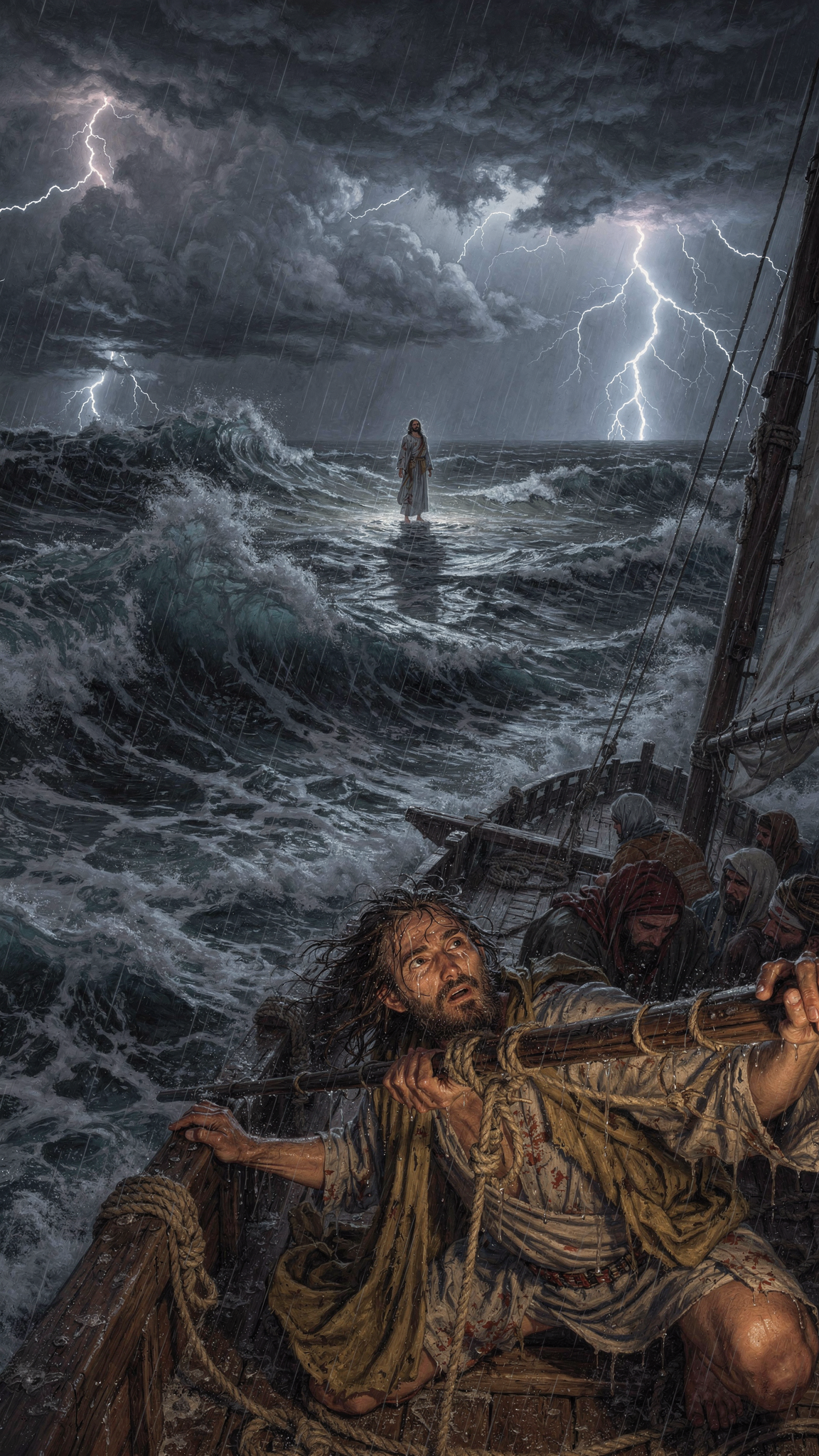
This moment unfolds on the Sea of Galilee, notorious for sudden, violent storms caused by cool air rushing down surrounding hills. The disciples—many seasoned fishermen—aren’t being dramatic. This is real danger, in the dark, with waves overtaking the boat.
Jesus approaches
walking on the water
a deliberate echo of God’s dominion over chaos (Genesis 1, Psalm 77). Their fear isn’t just the storm—it’s that they don’t yet recognize Him in the middle of it.
❓ Did It Really Happen ❓
Remember, I don’t pick the verse, Spirit does, and I found out this was my assignment just two and half hours ago… so hold on to your breeches… I have no idea which way this will take me.
I could take the safe road and just jump straight into the allegory angle, or I could take the “too smart for my own good” step and simply say it didn’t happen then jump into the allegory or “cliche of the day”.
Oh yes, it's easy to form a good message by the words in Chapter 14, but that’s just boring and the topic is important (immensely important!!!)— more than we know. I write this as the words of my father enter my mind, “Do you believe Jesus walked on water?”
By the end of this process, starting with an open mind to revisit the story, we’ll see which category I fall into. The chaplain who would skip the controversy of this verse in a sermon, or the one that invokes the “inerrant word of God”? Maybe I go for the dodge and say “go ask Reverend Jean what she thinks.”
You are again witnessing how I do my practice. No objective— no expected or rehearsed outcomes— just a passenger in my car that I have given Someone else the keys to— not dodging, but along for the ride.

Queue the Beat!
Ancient readers knew how to write allegory. This isn’t it—nothing in chapter 14 is. Not by a long shot. You could throw the Good Book into the air, and it would most likely fall open to an allegory or parable every time. Not this chapter!
Here is what can be easily observed by everyone— test it yourself.
Chapter 14 is a narrative
EXTRA! EXTRA. Read all about it!!
LIVE! From the Sea of Galilee…
Key observations:
No interpretive cues (“He spoke a parable”… “it was like”)
No symbolic explanation afterward
Immediate physical reactions: fear, confusion, Peter also stepping out
The story ends with the storm ceasing and the boat reaching land
This reads like reported memory, not crafted symbolism.
And it isn’t just Matthew, all the Gospel writers speak of the event in matter of fact tones.
It fails the “embarrassment” test. If you are inventing propaganda this is a terrible choice! Why?
The disciples look terrified and confused
They mistake Jesus for a ghost
Peter, “The Rock”, fails publicly
Jesus doesn’t explain Himself (<— big point!)
Invented miracle stories in antiquity usually:
Make heroes look competent
Clarify the lesson
Reinforce authority cleanly
This story does none of that. It preserves awkwardness, which historians suggest was simply a sign of early, unpolished tradition. The fact they say so tells me they had an eyebrow raised in their own self-doubt that, maybe, it really did happen.
Objections against this usually come down to one argument— the natural law argument.
Alas— the failure there is (and science would agree as I will show), natural law describes what normally happens, not what must always happen. This Gospel claim is not that the universe behaves randomly, its claim is:
The one who ordered nature can act within it!
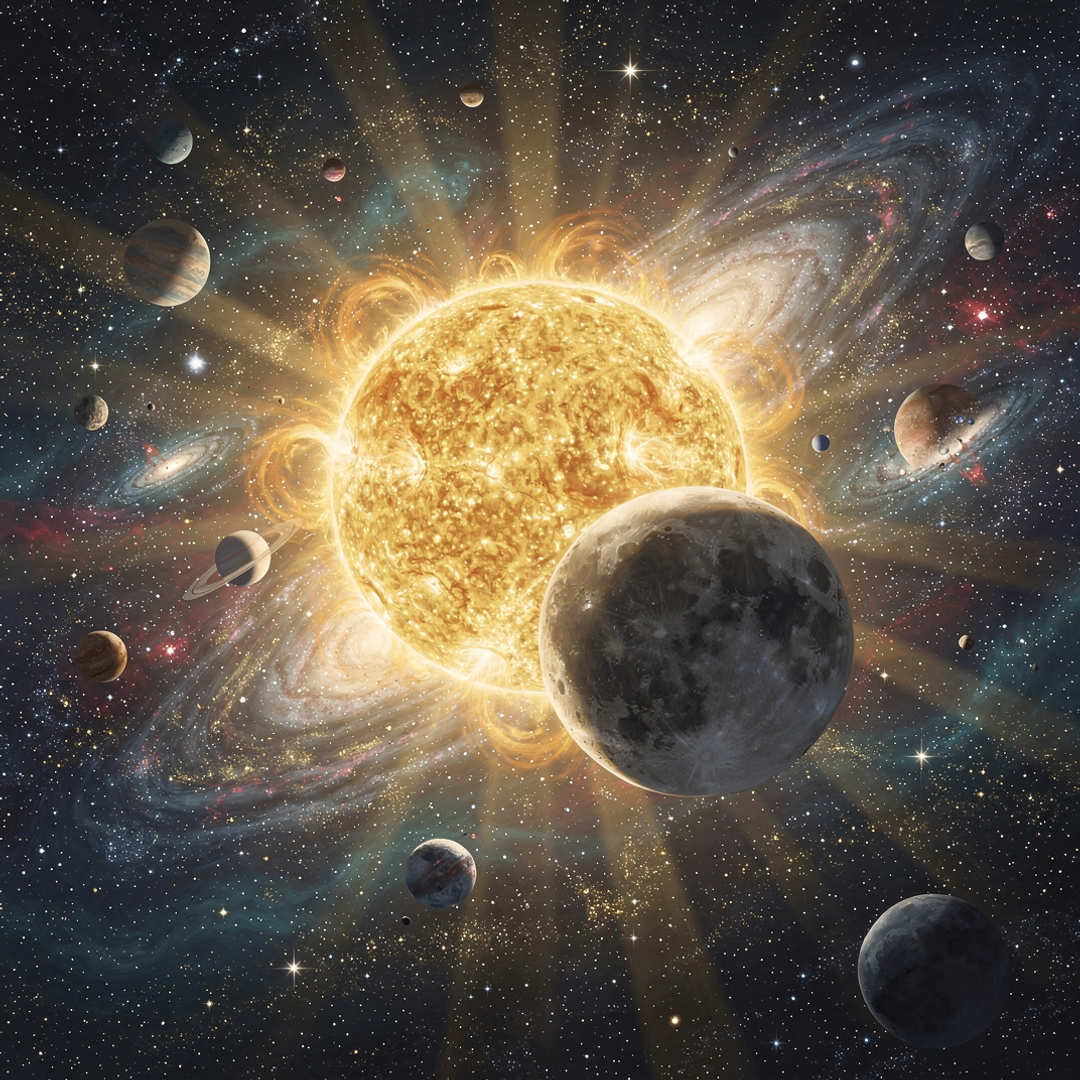
Let there be lights in the vault of the sky to separate the day from the night, and let them serve as signs to mark sacred times, and days and years, and let them be lights in the vault of the sky to give light on the earth.” And it was so. God made two great lights—the greater light to govern the day and the lesser light to govern the night. He also made the stars. God set them in the vault of the sky to give light on the earth, to govern the day and the night, and to separate light from darkness. And God saw that it was good. And there was evening, and there was morning—the fourth day. —Genesis 1: 14-19
So the question becomes:
Is a miracle possible in principle?
And if so, is this account credible within its historical context?
That’s a much narrower, fairer discussion and it deserves our attention…..
…over two days. 😄
This is part 1 of 2. Yes, tomorrow is Saturday and I hope you will join me!
This Gospel doesn’t ask us to suspend reason—it asks us to recognize the kind of claim being made. This story is told as an event, preserved with awkward detail, and rooted in a Jewish worldview where God’s authority over chaos was already assumed. Whether one accepts it or not, it wasn’t written as metaphor, and it wasn’t received as one by the first listeners.
It’s fair to say we have established that:
The writers meant this to be taken seriously
The claim fits their worldview
The text resists mythical polishing (despite my images attached)
All that being true, and generally not disputed by scrutiny, then the spiritual meaning, the symbology, and the allegory that is present in this story lands with much greater and profound weight as we’ll see. That’s for tomorrow and a lot more (unless everyone unsubscribes to this email by then).
I hope with this introduction you recognize that the story may have merit and the non-believing crows out there don’t get easy scraps from me the next day or so. They will have to wrestle with the claim itself as we all do.
❓ The Meaning
When we dig into the translation, the story gets even more compelling. A story that should be talked about differently among the clergy.
The nine words Jesus speaks here, “Take courage! It is I, do not be afraid.” have far more meaning than you may have ever thought…
When Jesus calls out to them through the storm, the Greek text reads:
"Tharseite, ego eimi; mē phobeisthe."
While most Bibles translate this as "Take courage! It is I. Don’t be afraid," there is a massive linguistic "Easter Egg" in that middle phrase. An easter egg, for those that may not know— is an intentional surprise hidden (often in plain sight) that has value beyond the words themselves.
1. The Divine Name: Ego\ Eimi
The phrase Ego\ Eimi (ἐγώ εἰμι) literally translates to "I am." In a vacuum, it’s a common way to say "It's me." But in the context of a man walking on a liquid surface during a life-threatening storm, it carries the weight of the Septuagint (the Greek translation of the Old Testament).
Exodus 3:14: When Moses asks God for His name at the burning bush, God responds with "I AM WHO I AM." In the Septuagint, that is written as Ego\ Eimi.
Isaiah 43:10: "Understand that I am (Ego\ Eimi); before me no god was formed."
By using these specific words, Jesus isn't just identifying himself to his friends ("Hey guys, it’s Matt’s friend Jesus"); he is using the formal, covenantal Name of God. He is essentially saying, "Take courage; the Creator of the Universe is standing on the waves." The trinitarian aspect of Jesus transformed into the I AM in that moment.
I’m already much deeper into this story than I had imagined I would be. An hour ago I was thinking, “Where am I going to go with this one?” Now I’m thinking, “Holy smokes, this is actually bigger than I ever imagined.”
This is where personal prayer and reflection is important. When I start to feel movement toward Wisdom and Spiritual truth, I find giving my creative side (the left brain) a little Divine Pecan Punch so Spirit can take me even farther. Hold the booze though…
🤵 Pastoral Word
When you are confronted with a conflict in our earthly understanding of nature and a Spiritual claim that we’ve not experienced ourselves, we often find we begin to test and question reality or our faith.
How convenient that is. why you ask? Because it PROVES GOD. It proves God’s love— it proves creation! Without the question there would never be an answer— never a hallelujah! Without the question, no discovery, no invention, and no creation.
We live in a God-given sandbox and are small children learning the ways of the cosmos and the infinite mysteries it presents to us. How fun it is!!
Last point to ponder until tomorrow: What pre-established natural laws are under pressure today? The question matters, and I’ll answer that tomorrow.
Stay tuned and stay curious! Each section above will be added to on Saturday. Tomorrow’s title is already established:
The Fourth Watch
The beat draws silent— mic drop— intermission
🙏 Pray
Dear God,
Thank you for the gift of mystery,
a colorful toy that leads to discovery.
Thank you for the ancient words that provide me joy,
Like a jigsaw puzzle on a snowy day.
Thank you for the challenge of discovery,
and moments where frustration led me to Grace.
Thank you for humbling me,
so surrender could open my heart.
The greatest discovery of all required a great deal of me
Anxiety, depression, and self-inflicted abuse of my Temple
I am thankful for all of it
Amen
🔥 Carry this With You Today
With God, anything is possible.