Dour Grapes

🌎 The World Before the Word
It didn’t happen all at once.
The week had been long.
Deadlines stacked.
Sleep shortened.
One unexpected problem after another.
Nothing catastrophic — just enough pressure to keep the nervous system tight.
Then someone asked a simple question.
And the response came out sharp.
Not explosive.
Just clipped.
Dismissive.
Later, another comment slipped out.
Then another.
You could feel it in real time — the tone turning sour.
Not because you’re an angry person.
But because stress had quietly taken the wheel.
The atmosphere around you changed.
And everyone knew it.
The Old Reflex
The old reflex moves in two directions.
First comes justification.
“I’m just under a lot right now.”
“They should understand.”
“It’s been a rough week.”
Then comes self-criticism.
“Why am I like this?”
“I should be better than that.”
One reflex protects the ego.
The other punishes it.
Neither actually restores the heart.
Stress doesn’t create character out of nowhere.
It exposes where the interior life has been stretched thin.
🌿The new Covenant Posture
The New Covenant posture is honest surrender.
A living sacrifice does not pretend stress isn’t real.
It simply refuses to let stress define the spirit.
The posture becomes:
Notice the drift quickly.
Own the tone without defensiveness.
Return the heart to God.
Sometimes the most spiritual act is a quiet correction.
An apology.
A softened word.
A renewed presence.
Grace makes that possible.
You do not have to defend a bad moment.
You are free to realign.
📜 The Word
“Let every person be quick to hear, slow to speak, slow to anger; for the anger of man does not produce the righteousness of God”
📖 James 1:19-20
James writes to scattered Jewish Christians witnessing hardship and social pressure. His instruction recognizes how easily stress converts into reaction. Spiritual maturity shows up in slowed responses and controlled tone.
“A soft answer turns away wrath, but a harsh word stirs up anger.”
📖 Proverbs 55:1
Proverb’s wisdom literature treats speech as directional— horizontally and vertically. Words can either diffuse tension or accelerate it. Tone becomes a form of signal strength, physical posture a multiplier. These are added into our intention which causes a similar reaction within whom we are speaking to. Assume we’re always speaking to God.
The issue is not perfection.
It is awareness and correction.
Human beings move through the day in emotional rhythms.
Most moments are reactive or distracted.
But occasionally a quiet opening appears — when the mind is calm enough to listen and unsettled enough to seek meaning.
🤵 Pastoral Word
I write this topic today because something very similar went down today for me. I was taken out of grace for a moment when stress seemed to enter into the environment. As the boss, I snapped and sent someone away and set to work myself.
He wasn’t wrong to be stressed; I wasn’t wrong to react. Stuff happens. The trick is how soon you get back into grace and I managed to find a decent rhythm fairly quickly. I can’t speak for my friend—although it seemed he bounced back nicely too. I love that!
Here is how you find balance quickly. When you are frustrated, you are “praying frustration”. When you are happy, you are “praying happiness”. The strength of your frustration (I AM REALLY MAD!!) is the power behind your prayer. So know that the more emotionally aroused you are (really mad, REALLY mad) is your signal strength to God. For me, that brings me back down to Grace VERY quickly.
So let me show you a little fun and interesting “data”. Unbeknownst to my friend, I was testing my “posture” analyzer all day. Below is a snapshot of my day— and it probably aligns nicely with just about anyone’s day.
You start off receptive, calm, even motivated. For me, morning gratitude, prayer, reflection where I paint my own sunrise. Day starts, things happen, things may get tense. Day slows. Go to bed… start again tomorrow.
All captured in my personal trend line this very day in the image here:
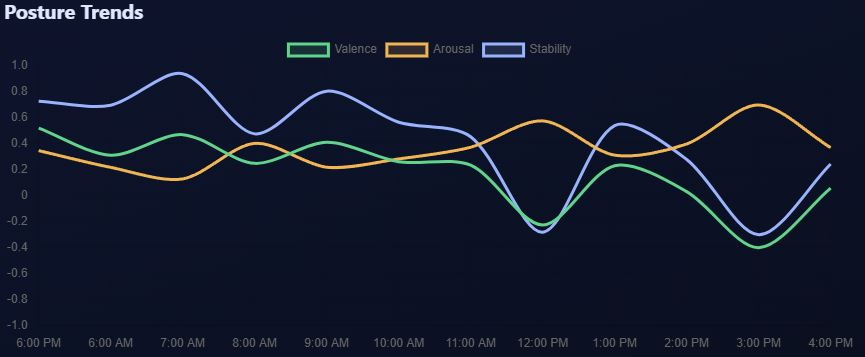
Quick description:
Valence (green) = emotional “tone” (negative -1 to positive 1)
Stability (purple) = groundedness/settledness (turbulent to settled).
Arousal (Orange) = the “signal strength” of the emotion (how happy, how sad).
The system detects hundreds of emotions (the system has detected more than 200!)— happy, sad, frustrated, confused… all have a “valence” score associated with them. Angry might be -.4, while joyful might be +.4. Stability is all the emotions— good, bad, neutral, calculated together. Arousal is the STRENGTH of all of them at that time period.
What you’ll find in life, is that positive emotions follow the “arousal” upward, while negative emotions split from the arousal line and move down. As you can see— the more intense the event, the more they split— God line up, negative emotion line down.
Your purple line is WHAT you are asking of Him (above zero, positive, below— negative).
Your yellow is the determination in your asking. Your “conviction”.
So, what gift do you choose to bring to Him at any given moment? And with how much conviction?
Now, apply that same consideration with your neighbor in every circumstance.

🙏 Let's Pray
May you walk through pressure today with a guarded heart.
When stress rises and patience thins,
may awareness come quickly.
May you recognize the moment your tone begins to drift
and gently bring it back.
You are not defined by a tense moment.
You are shaped by how quickly you return to grace.
May humility keep your spirit soft.
May awareness keep your words steady.
May peace regain the center of your presence.
And when pressure presses in,
may your surrender become visible
in patience,
in kindness,
in restraint.
That quiet composure?
…it’s worship.
Amen
🔥 Carry this With You Today
Stress will not decide my spirit.